
What Is DayLox.com?
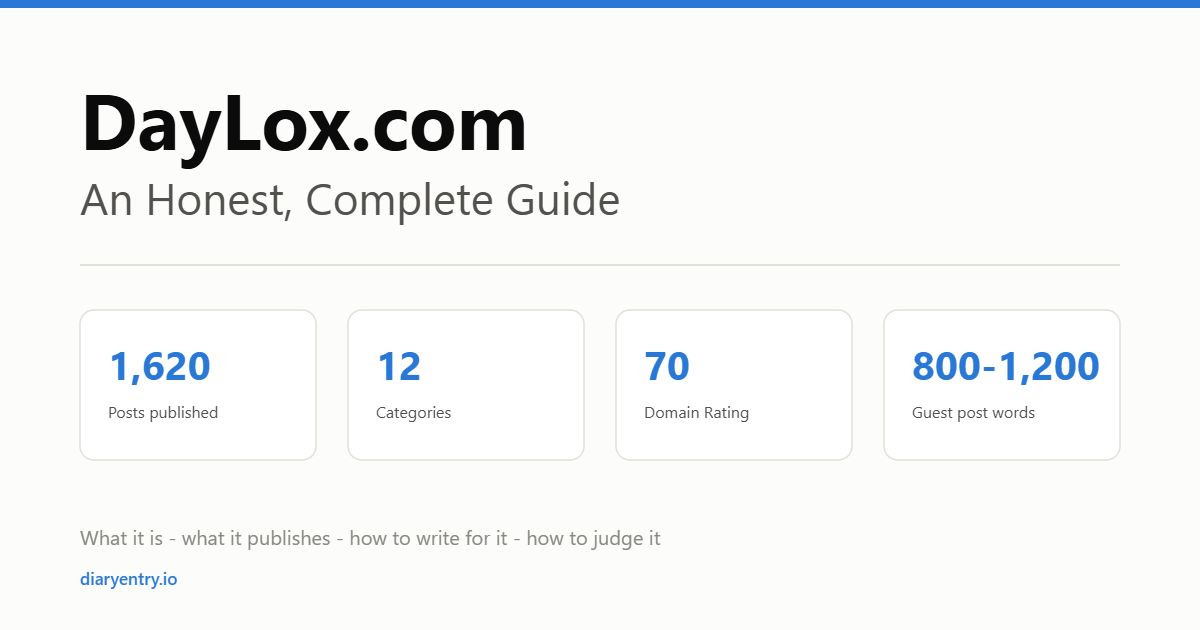
DayLox is a WordPress-based website at daylox.com that presents itself as a daily companion for intentional living. Its homepage headline reads “DayLox – Transform Today Into Your Best Yet”, with the tagline “Elevate Every Moment Today”, and the site describes itself as “blending wellness, productivity, and tech into one seamless experience”. According to DayLox, the stated aim is to help people “maximize focus, elevate energy, and cultivate mindfulness”.
That framing is worth reading carefully, because the language sounds like a product but the site does not behave like one. There is no app, no download link, no signup, no web dashboard and no product demo anywhere on daylox.com. The primary call to action on the homepage is a “Contact Us” button. Everything the site offers a visitor today is either published content or an email conversation.
In practice, DayLox is best understood as a content site with a wellness-and-productivity presentation layer. It runs on WordPress with a LiteSpeed server and Yoast SEO, publishes across twelve categories, and carries roughly 1,620 posts. It also runs a “Write For Us” guest-contribution programme, which is the most concrete and actionable thing on the site.
What this guide covers
This guide is written for readers who found DayLox through a search result, a guest-posting shortlist, or a link-building outreach email, and want to know what they are actually looking at before spending time on it. It is descriptive rather than promotional. Where the facts support a positive reading, we say so; where they don’t, we say that too.
- The six features DayLox describes on its homepage — quoted as written, and clearly flagged as described rather than tested, because there is no product to test.
- What the site actually publishes — a measured breakdown of a large sample of its live URLs, which differs substantially from its stated subject matter.
- The Write For Us programme — accepted topics, word count, tone requirements, how to submit, and stated response time.
- How DayLox compares with established tools people usually mean when they talk about habit, mood and focus tracking.
- A general evaluation checklist you can apply to any site inviting your byline, not just this one.
- An honest verdict on who DayLox is and isn’t useful for.
DayLox at a glance
| Attribute | What we found |
|---|---|
| Name | DayLox (daylox.com; canonical host www.daylox.com) |
| Type | WordPress content site presented as a wellness and productivity brand |
| Domain Rating | 70 (third-party Ahrefs metric, checked August 2026) — genuinely high for a site of this kind |
| Published posts | Approximately 1,620, across nine post sitemaps |
| Categories | 12 in total, spanning wellness, productivity, technology, mental health, startup news, business, education and general blog content |
| Static pages | 7 — home, about, contact, write for us, disclaimer, privacy policy, terms |
| Primary CTA | Contact only. No signup, no app, no dashboard |
| Pricing | None published anywhere on the site |
| Named founder, team or company | None published |
One figure in that table deserves flagging early: the Domain Rating of 70. That is high, and it is the main reason DayLox appears on guest-posting shortlists. It is worth understanding what that number does and does not tell you, which is covered in the by-the-numbers section further down.
Nothing in this guide should be read as a verified product review. There is no product to review — only a website, its stated intentions, and its published output. We stick to what can be observed.
The Six Features DayLox Describes
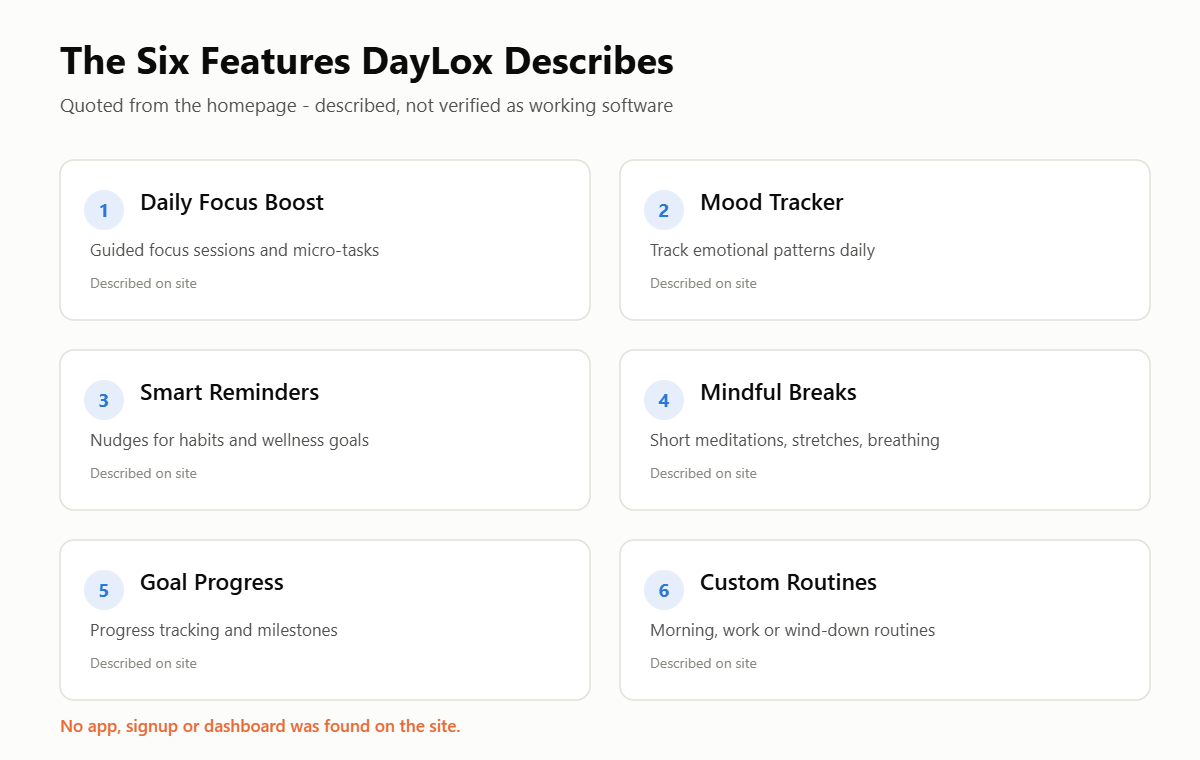
The DayLox homepage sets out six features in a grid, each carrying a single line of description. Together they are the clearest statement the site makes about what it intends to be, so they are worth reading closely and quoting exactly.
One caveat applies to all six, and it is the reason this section is worded the way it is. These features are described on the site; they are not demonstrated by it. No app, download link, signup, web app or product demo could be found anywhere on daylox.com — the only route the homepage offers is a “Contact Us” button. What follows is therefore a reading of published copy, not a review of working software.
For each feature I quote the site’s wording verbatim, then add a short note on what a feature of that name typically does in productivity and wellness tools generally. That general context is drawn from the wider category, not from anything DayLox has shown, and is labelled as such throughout. It is included so you can judge how much each one-line description actually commits to.
Daily Focus Boost
“Sharpen your mind with guided focus sessions and micro-tasks.”
General context: in productivity software, a “focus session” is usually a timed working interval — the Pomodoro technique’s 25 minutes of work followed by a short break is the best-known form, with time-blocking as the calendar-based cousin. “Guided” normally means the timer is wrapped in something: a start ritual, ambient audio, or a prompt to name the task first. “Micro-tasks” generally refers to breaking work into units small enough that starting costs nothing.
The DayLox line does not specify session length, whether guidance is audio or text, or whether micro-tasks are supplied by the tool or written by the user. Those are the details that decide whether such a feature is useful, and they are not published.
Mood Tracker
“Track emotional patterns and improve your mental clarity daily.”
General context: mood tracking in apps such as Daylio typically means a very fast daily check-in — a point on a small scale, sometimes tagged with activities or notes — which is then charted over weeks so patterns become visible. The value comes almost entirely from consistency and from reviewing the history; a single entry tells you nothing.
Note that the second half of the DayLox sentence describes an outcome (“improve your mental clarity”) rather than a mechanism. Note too that mood data is personal data. Where it would be stored, and under what terms, is not something the homepage addresses; the site does publish a Privacy Policy page in its footer, which is where anyone acting on this feature would need to start.
Smart Reminders
“Get nudges to stay on track with your habits and wellness goals.”
General context: reminder systems sit on a spectrum. At the simple end are fixed recurring notifications at a set time, the model used by habit apps such as Streaks and by task managers such as Todoist. At the other end are adaptive prompts that respond to location, calendar state, or whether you actually completed the thing yesterday. The word “smart” usually signals the second kind.
DayLox’s description does not say which end of that spectrum it refers to, nor on what device the nudges would arrive — which matters, given no app is published.
Mindful Breaks
“Relax with short meditations, stretches, or breathing cues.”
General context: this is the most conventional of the six. Short guided practices are the core of Headspace and Calm, and breathing cues in particular are well standardised — box breathing (four counts in, hold, out, hold) is the usual starting point, with movement or stretch prompts serving the same purpose for desk-bound work. Content of this kind is expensive to produce well, because it usually requires a recorded library rather than a piece of interface.
The site does not indicate whether the meditations, stretches and breathing cues are audio, text or animation, nor how many exist.
Goal Progress
“Visualize your growth with progress tracking and milestones.”
General context: progress visualisation generally takes one of a few well-worn forms — streak counters, completion percentages, calendar heat maps, or simple line charts. “Milestones” normally means intermediate checkpoints between where you are and a longer goal, which is a sound idea in habit design because it shortens the gap between effort and visible reward.
What form DayLox’s visualisation takes, and what it would be reading data from in the absence of a product, is not stated.
Custom Routines
“Build and personalize your own morning, work, or wind-down routine.”
General context: a routine builder usually lets you sequence steps with durations and run them as a chain, so a morning routine becomes one thing you start rather than six things you remember. People assemble the same effect manually in Notion templates or in checklist apps.
Of the six, this is the one that leans least on a content library and most on the user’s own input — which in general makes it cheaper to build and easier to make genuinely personal, though again there is nothing published that shows it working.
What the six descriptions have in common
Read together, the set is coherent: focus, mood, reminders, breaks, progress and routines is a reasonable spine for a daily-habits product, and the six do not overlap much. What each description lacks is a mechanism. None names a platform, a format, a data model or a way to try it. That is not unusual for homepage copy taken alone — but on most sites the copy sits above a signup form or a download button that settles the question, and here it does not.
If any of these six matter to you specifically, the practical questions to put to the site’s contact address are straightforward:
- Is there a working product behind these six descriptions, and if so, where is it accessed?
- What platform does it run on, and is anything available to try?
- For the Mood Tracker in particular: where is entered data stored, and who can access it?
- Are the meditations, stretches and breathing cues an existing library, or planned?
Until those are answered, the honest description is the one the site’s own copy supports: six features described on a homepage, with no published way to use them.
What DayLox Publishes
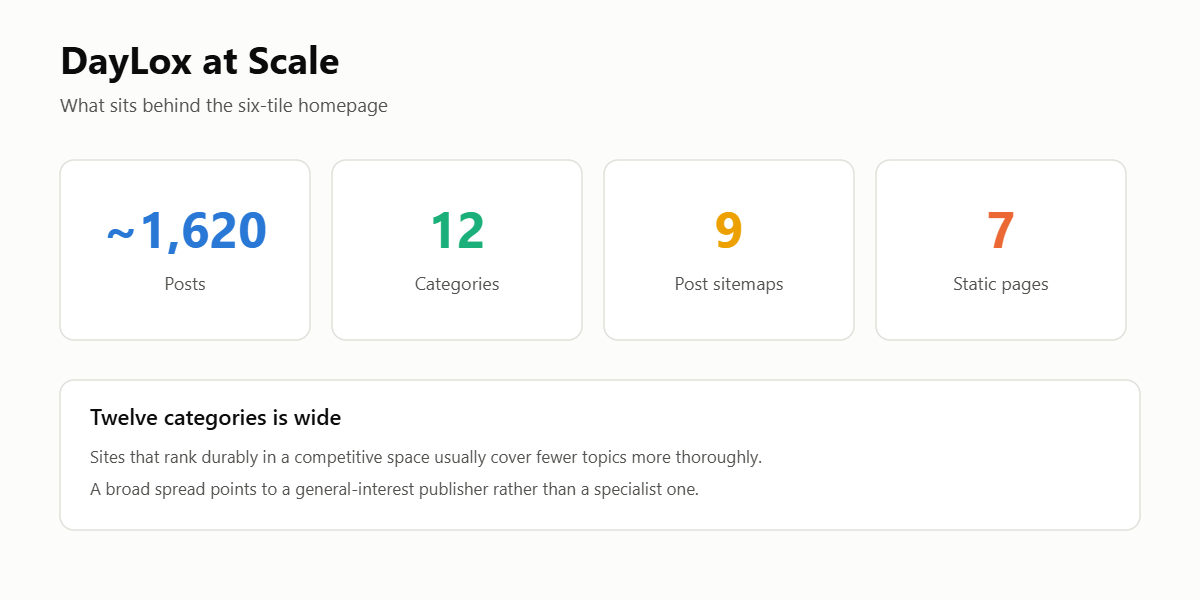
Beyond the six features on its homepage, DayLox is first and foremost a publishing operation. It runs roughly 1,620 posts spread across nine separate post sitemaps, organised into twelve categories. For a site that presents a compact six-tile feature grid on its front page, that is a substantial archive sitting behind it.
The categories that carry the site’s stated identity are the ones named in the main navigation: Tech Updates, Productivity, Startup News, Wellness and Mental Health. Alongside those, the category list also includes health, tech, business, education, gaming and a general blog catch-all.
What that structure tells you
Two observations are worth drawing from the shape of the archive rather than from any single post.
The first is breadth over depth. Twelve categories on one domain is wide. Sites that rank durably in a competitive space such as wellness usually go the other way — fewer categories, covered more thoroughly, with strong internal linking between related pieces. A twelve-category spread suggests a general-interest publisher rather than a specialist one, and that is worth knowing if you arrived expecting a focused wellness resource.
The second is volume relative to age. Roughly 1,620 posts is a lot of output. Sustaining that pace on original, edited content requires a real editorial team, and DayLox does not name one — the About page refers only to “a team of creators, thinkers, and optimists”. That is not evidence of anything improper; it is simply a gap in what you can verify before deciding how much weight to give the site.
If you are evaluating DayLox as a reader, the practical advice is the same as for any large general-interest site: judge the individual article in front of you on its own merits rather than inheriting trust from the domain. If you are evaluating it as a potential publishing venue, browse the recent posts in the category you would be writing for and ask whether your byline would sit comfortably among them. That is a two-minute check and it tells you more than any metric.
DayLox by the Numbers
Third-party data gives us a few hard figures about DayLox that the site itself does not publish. As measured on 9 August 2026, the domain carries an Ahrefs Domain Rating of 70 and an Ahrefs Rank of 118,209. A crawl of its Yoast sitemap index found roughly 1,620 posts spread across nine post sitemaps, and the site runs 12 categories in total.
| Metric | Figure | What it actually tells you |
|---|---|---|
| Domain Rating (Ahrefs) | 70 | The estimated strength of the site’s backlink profile on a 0–100 scale. High. |
| Ahrefs Rank | 118,209 | Its position when every domain in Ahrefs’ index is ordered by backlink strength. |
| Published posts | ~1,620 | A large archive for a site of this kind. Says nothing about what is in it. |
| Post sitemaps | 9 | Yoast splits sitemaps at a fixed post count, so this is a volume signal. |
| Categories | 12 | Six more than the six sections shown in the site’s navigation menu. |
What Domain Rating actually measures
Domain Rating is Ahrefs’ own metric. It scores a domain from 0 to 100 based on the size and quality of its backlink profile: how many unique other domains link to it, weighted by how strong those linking domains are themselves. The scale is logarithmic, so the gap between DR 60 and DR 70 represents far more link equity than the gap between DR 20 and DR 30. A DR of 70 means a lot of other websites, including some reasonably strong ones, point at daylox.com.
Two things follow from that definition, and both matter.
First, Domain Rating is calculated entirely from links. It contains no information about traffic, revenue, audience size, editorial standards, factual accuracy, or how long anything stays published. A site with no readers at all can hold a high DR if enough domains link to it.
Second, Google does not use Domain Rating. It is a vendor’s model of the link graph, built from a vendor’s crawl, and it is recalculated as that index refreshes. Ahrefs Rank has the same character: 118,209 is a relative ordering among indexed domains, not an audience figure. Treat both as useful shorthand, not as a verdict.
Why a high DR is not, on its own, a reason to publish somewhere
This is the part that trips people up, particularly writers weighing a guest-post pitch. DR tells you about a site’s inbound links. It does not tell you any of the following:
- Whether the site gets readers. Backlink strength and organic traffic are separate metrics. A link from a page nobody visits sends nobody to your work.
- Whether the site ranks for anything you care about. Topical relevance is not baked into DR. A strong domain in one subject area carries little weight in an unrelated one.
- What your article will sit beside. DR is a domain-level number. It is blind to the other 1,619 posts, and to what those posts are about — which, on this site, is the single most important thing to check. That analysis has its own section below.
- Whether outbound links are followed at all. Many publishers apply nofollow or sponsored attributes to author-bio links, which removes the SEO rationale entirely.
- Whether the page will still exist next year. Archives get pruned, domains change hands, and a byline can quietly disappear.
- How the links were acquired. DR treats a link as a link. The score has no view on whether a profile was built editorially or otherwise.
A more useful way to read these figures
Use DR as a filter, never as a decision. If a site’s DR is very low, you learn something quickly. If it is high, you have learned only that the number is high, and the real work starts: look at estimated organic traffic, check which pages actually rank, open the ten most recent posts, and read the categories list rather than the navigation menu. On DayLox the menu shows six sections while the taxonomy holds twelve — a discrepancy you would miss entirely if you stopped at DR 70. Volume figures deserve the same treatment. Nine sitemaps and around 1,620 posts indicate a high publishing cadence; cadence and quality are unrelated variables.
None of this makes a DR 70 domain a bad one. It makes it an unknown one until you look at the content, which is precisely what the next sections do.
Writing for DayLox: The Complete Submission Guide
The Write For Us page is the most concrete, actionable thing on the site. If you write about habits, productivity or mindfulness and you are building a portfolio, it is a live opportunity with published, specific requirements — which is more than many sites offer.
What they accept
DayLox lists five topic areas it wants:
- Daily habits that lead to success — routine design, habit formation, consistency
- Mindfulness, meditation and mental clarity — contemplative practice and attention
- Productivity hacks that actually work — note the emphasis on actually; they are signalling fatigue with recycled advice
- Personal transformation narratives — first-person accounts of change
- Purpose-driven living and intentional mindset — the values layer beneath the tactics
The specification
| Requirement | What DayLox states |
|---|---|
| Word count | 800–1,200 words |
| Tone | “clear, conversational tone—human and honest” |
| Not wanted | “fluff, clickbait, or overly promotional language” |
| Originality | Must be original and unpublished elsewhere |
| Author bio | Short bio permitted, “and, if you like, a link to your website or socials” |
| How to submit | Email an idea or a finished draft to lesley.official47@gmail.com |
| Subject line | “Write for DayLox” |
| Response time | “within 7–10 business days” |
| Payment | Not mentioned in either direction — no stated fee to writers, and no stated charge |
Reading the brief properly
Three details in that specification carry more weight than they first appear to.
800–1,200 words is short. That is a single-idea length. It is not enough room for a comprehensive guide, so do not pitch one — pitch one argument, developed properly, with a concrete example. Submissions that try to cover a whole topic at 1,000 words read as thin, and thin is the most common reason a piece is turned down.
“Human and honest” is a real constraint. Paired with the explicit rejection of “fluff, clickbait, or overly promotional language”, the brief is asking for first-person specificity: what you tried, what happened, what you would do differently. Generic listicles assembled from other listicles are exactly what this wording is written to filter out.
The bio link is optional and phrased casually — “if you like”. Treat the link as a courtesy rather than the point of the exercise. Pieces written backwards from a desired link tend to show it, and editors are practised at spotting them.
A practical pitching approach
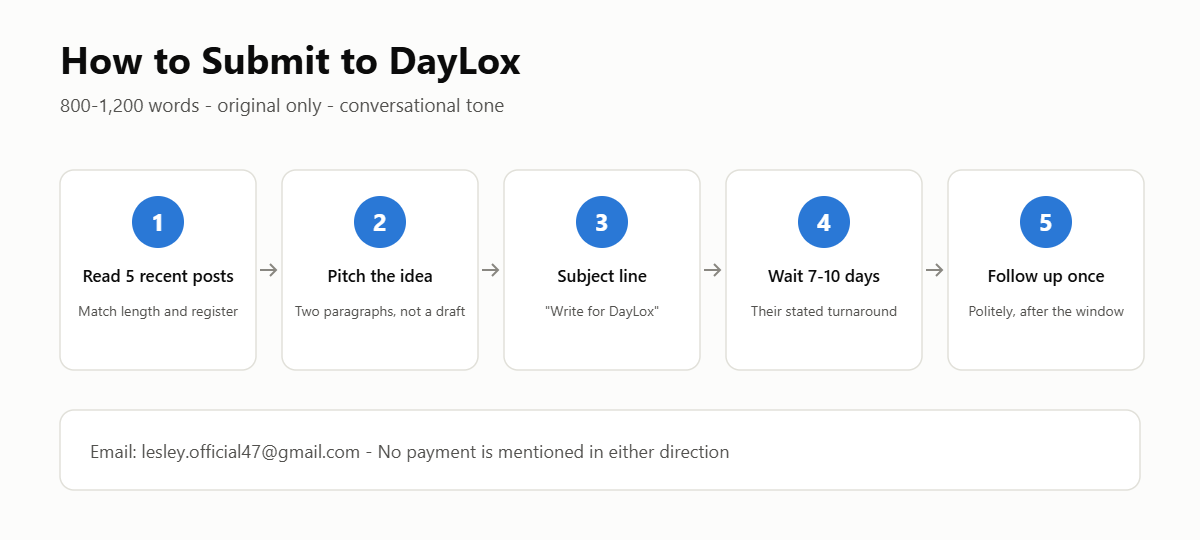
- Read five recent posts in the category you are targeting. Match their length, structure and register.
- Pitch the idea before writing the draft. The page accepts either, but a two-paragraph pitch costs you twenty minutes instead of four hours if the answer is no.
- Lead with the specific claim, not the topic. “Why I stopped time-blocking after three years” is a pitch; “an article about productivity” is not.
- Use the exact subject line they ask for. It is almost certainly how submissions get filtered.
- Wait the full 7–10 business days before following up once, politely.
Who Is DayLox For?
Whether DayLox is worth your time depends entirely on which of two groups you fall into, and the answer is quite different for each.
If you are a reader
Set your expectations at the right level. There is no product to use — no app, no signup, no dashboard. What is on offer is published articles about habits, focus, mindfulness and adjacent topics. On that basis it functions as a general-interest blog rather than a tool, and it is best judged article by article.
If you came looking for something to actually track your mood or run focus sessions, you will need one of the established apps covered in the comparison below. The six features on the DayLox homepage describe an experience, but nothing on the site lets you use it today.
If you are a writer
This is where DayLox is genuinely worth considering. The Write For Us programme has published, specific requirements, a named contact, and a stated turnaround — three things that a surprising number of guest-post pages lack. For a writer building a portfolio in the habits-and-productivity space, a clip is a clip, and the 800–1,200 word format is an achievable target.
Two things to weigh before you commit the time. First, no payment is mentioned, so assume the exchange is exposure and a bio link rather than a fee, and decide whether that trade works for you. Second, apply the two-minute check described earlier: read the recent posts in your target category and confirm your byline sits comfortably among them. That judgement is yours to make, and it is worth making before you write rather than after you publish.
If you are doing outreach or link building
The Domain Rating of 70 is what puts DayLox on shortlists, and the next section explains precisely why that number should not be the deciding factor.
Who Runs DayLox?
This is the shortest section in the guide, because there is very little published to report — which is itself the finding.
| Detail | What the site publishes |
|---|---|
| Contact email | lesley.official47@gmail.com (a free Gmail address) |
| Phone | +92 329 1484123 (+92 is Pakistan’s country code) |
| Address | 1595 Simpson Square, Oklahoma City, OK 73109 (United States) |
| Founder or team | Not named anywhere on the site |
| Registered company | Not published |
| Founding date | Not published |
The About page describes the people behind DayLox only as “a team of creators, thinkers, and optimists who understand that growth doesn’t come all at once—it comes daily”. It is warm copy, but it names no one.
Two factual observations follow, and both are offered without any accusation attached. The first is that the contact address is a free Gmail account rather than one on the daylox.com domain — unusual for a site running an archive of this size, since domain email is trivial to set up and reads as more established. The second is that the published phone number and the published postal address are on different continents.
Neither of these means anything is wrong. Distributed teams are ordinary, and plenty of legitimate small publishers use a Gmail address for convenience. But if you are deciding whether to hand over original writing, the absence of a named editor, a company entity, or a domain email means there is nobody specific you are dealing with and no entity standing behind the arrangement. That is a real consideration, and it is the sort of thing worth knowing before rather than after.
DayLox vs Established Alternatives
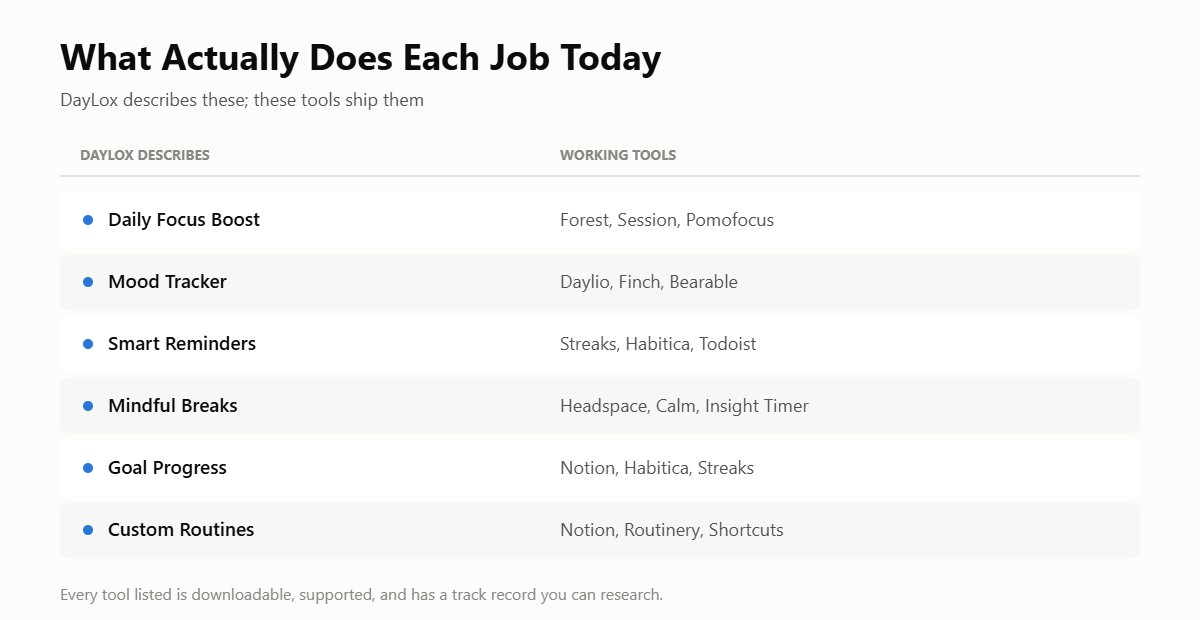
Because DayLox describes six features but does not ship a product, the honest comparison is not “DayLox versus X” — it is “here is what actually does each of those jobs today”. If a feature on that homepage grid is what drew you in, this table points you at tools you can install this afternoon.
| DayLox describes… | Tools that do this job | What to expect |
|---|---|---|
| Daily Focus Boost | Forest, Session, Pomofocus, Todoist | Timed work intervals, usually Pomodoro-style, often with ambient audio or a distraction blocker |
| Mood Tracker | Daylio, Finch, Bearable | A fast daily check-in on a small scale, tagged and charted so patterns emerge over weeks |
| Smart Reminders | Streaks, Habitica, Todoist, Apple Reminders | Scheduled or location-based nudges; the better ones adapt to whether you actually complete the task |
| Mindful Breaks | Headspace, Calm, Insight Timer | Short guided meditations, breathing exercises and stretch prompts, usually with a large session library |
| Goal Progress | Notion, Habitica, Streaks | Visual progress tracking, streak counts and milestone markers |
| Custom Routines | Notion, Routinery, Apple Shortcuts | Sequenced, personalised morning, work or wind-down routines you build yourself |
The honest framing
Every tool named above is a working, downloadable product with a support channel, a privacy policy covering your data, and — critically — a track record you can research before you trust it with a daily log of your mental state. DayLox currently offers a description of these capabilities rather than the capabilities themselves.
That is not a criticism of the idea. An all-in-one daily companion combining focus, mood, reminders, breaks, goals and routines is a genuinely appealing concept, and the fact that most people currently assemble it from three or four separate apps is a real gap. But a concept described on a homepage and a product you can rely on are different things, and only one of them helps you tomorrow morning.
If you want the DayLox concept today
The closest practical approximation is a two-app stack: one habit-and-routine tool (Notion or Streaks) plus one mood tracker (Daylio or Finch), with a meditation app added only if you will genuinely use it. Three apps is usually where people stop; anything beyond that tends to collapse under its own maintenance burden within a month.
How to Evaluate a Platform Like This
The most durable thing this guide can give you is not a verdict on one website but a repeatable method. The following checklist applies to any site inviting your byline, requesting a link exchange, or presenting itself as a tool you should trust.
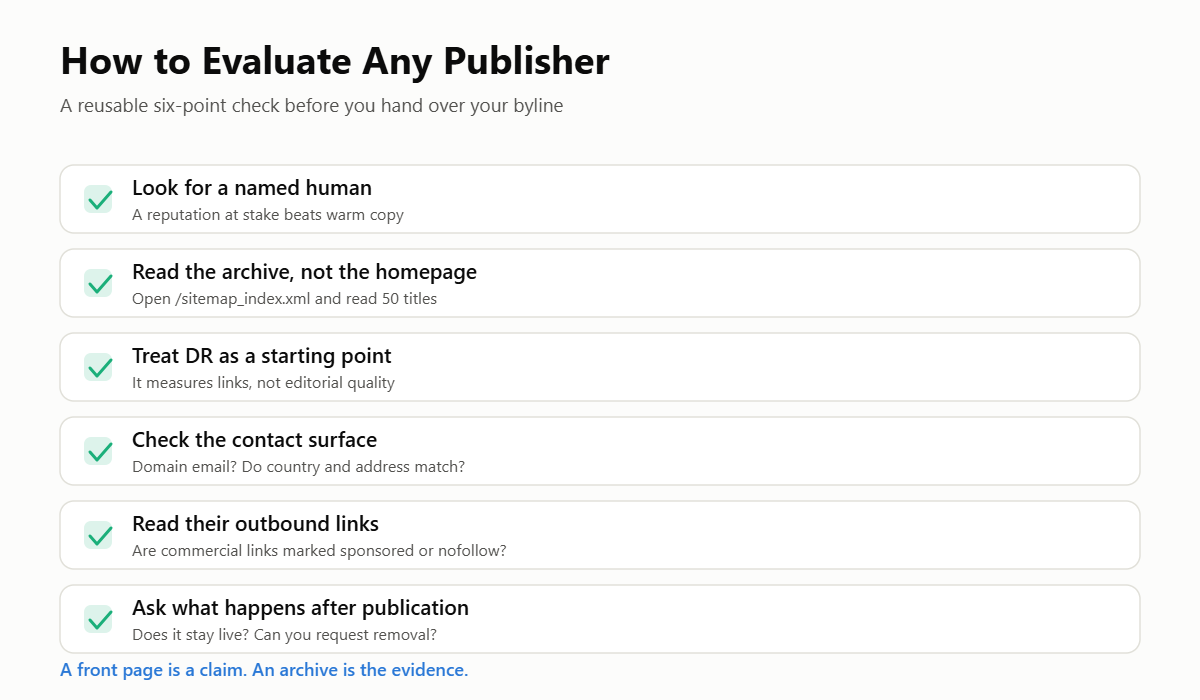
1. Look for a named human
Is there an editor, founder or author with a real name and a traceable presence? A named person has a reputation at stake. “A team of creators and optimists” does not. This is the single highest-signal check, and it takes thirty seconds.
2. Check whether the content matches the branding
Open the sitemap — usually at /sitemap_index.xml — and read fifty post titles rather than the five the homepage chooses to show you. A site’s archive is a far more honest description of what it is than its front page. If the archive and the branding tell different stories, believe the archive.
3. Treat Domain Rating as a starting point, never a verdict
DR measures the strength of a backlink profile. It does not measure editorial quality, audience, relevance, or whether a link from that site will help you. A high DR tells you a site has accumulated links; it says nothing about whether you want to be associated with it.
4. Check the contact surface
Domain email or free webmail? Does the phone number’s country match the stated address? Is there a real company entity? None of these is damning alone, but together they indicate how much substance sits behind the brand.
5. Read the outbound links on a few published posts
Where does the site send its readers, and are commercial links marked rel="sponsored" or rel="nofollow"? A publisher careless about its own outbound links is telling you how much editorial oversight exists.
6. Ask what happens after publication
Will the piece stay live? Will you keep the byline? Can you request removal later? These sound like pedantic questions until you need the answer, and a publisher worth writing for will answer them without friction.
The underlying principle: a website’s front page is a claim, and its archive is the evidence. Spend your two minutes on the evidence.
Frequently Asked Questions
Is DayLox free to use?
No pricing of any kind is published on the site. There is also nothing to pay for, since there is no product to subscribe to — the articles are freely readable.
Does DayLox have an app?
No app, download link, signup or web dashboard could be found anywhere on the site. The six features described on the homepage are not accessible as software today.
How do I contact DayLox?
By email at lesley.official47@gmail.com, by phone on +92 329 1484123, or through the contact page. Email is the route the site itself directs you to.
Can I write for DayLox?
Yes. The Write For Us page invites submissions on habits, mindfulness, productivity, personal transformation and intentional living.
How long should a DayLox guest post be?
800–1,200 words, as specified on their submission page.
How long does DayLox take to respond?
The site states a response “within 7–10 business days”.
Does DayLox pay writers?
No payment is mentioned in either direction. Assume the exchange is exposure and an optional bio link, and confirm before investing significant time.
Can I include a link in my author bio?
Yes. The guidelines say to include a short bio “and, if you like, a link to your website or socials”.
What is DayLox’s Domain Rating?
70, with an Ahrefs Rank of approximately 118,209 as checked in August 2026. DR is a third-party metric of backlink strength, not a measure of editorial quality.
How many articles has DayLox published?
Roughly 1,620 posts across nine post sitemaps, organised into twelve categories.
Who owns DayLox?
No founder, team member, or registered company is named anywhere on the site.
Is DayLox a legitimate website?
It is a real, live, actively publishing WordPress site with a substantial archive and a functioning submission process. What it is not is a verified software product — the features it describes are marketing copy for something you cannot currently use.
Are the statistics on the DayLox homepage accurate?
The homepage counters display “0 K+” focus sessions completed and “0%” user satisfaction. These are unpopulated placeholders rather than real figures, and should not be read as usage data.
Is DayLox good for building backlinks?
Its DR of 70 is why it appears on link-building lists. Whether a link from any given site helps you depends on relevance, editorial standards and context — none of which DR measures. Apply the six-point checklist above and decide for yourself.
What topics does DayLox cover?
Twelve categories in total, spanning wellness, productivity, technology, mental health, startup news, business, education and general blog content.
Should I use DayLox instead of a habit-tracking app?
No — it is not an alternative to one, because it is not an app. If you want the capabilities its homepage describes, use the established tools listed in the comparison section above.
The Verdict
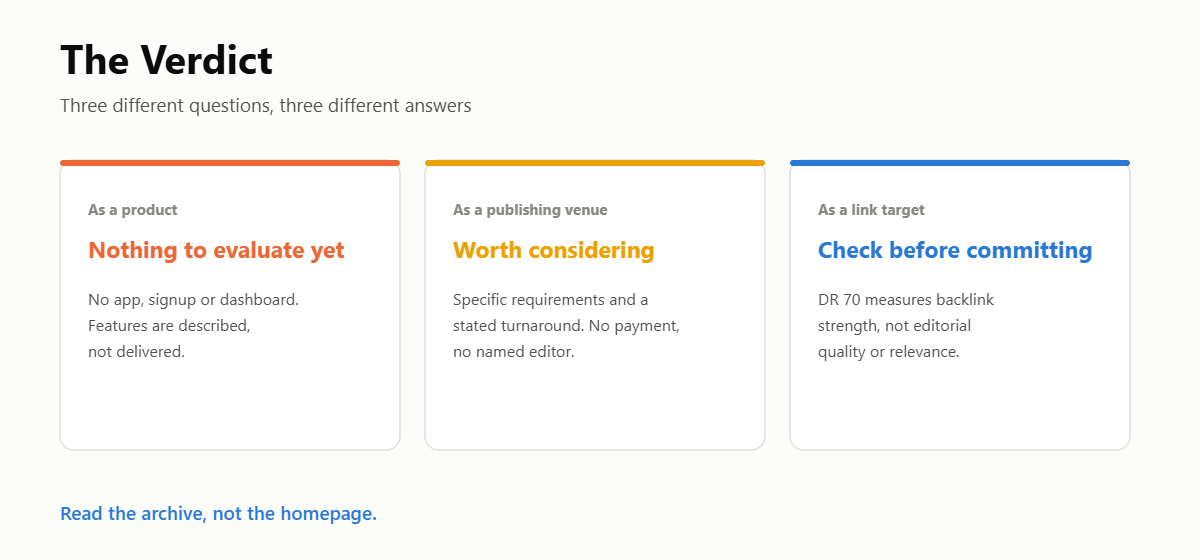
DayLox is a large, actively maintained content site presented with the visual language of a wellness product. Understanding it correctly means separating those two things.
As a product, there is nothing to evaluate yet. The six features are described rather than delivered, the homepage statistics are unpopulated placeholders, and the only action available to a visitor is sending an email. Anyone arriving expecting a focus timer or mood tracker should use one of the established apps instead.
As a publishing venue, it is a more interesting proposition. The Write For Us programme is specific, the requirements are published, and the turnaround is stated — a genuinely usable route for a writer building clips in the habits-and-productivity space. The trade-offs are that no payment is mentioned and no named editor stands behind the process, so go in with clear expectations.
As a link-building target, the DR of 70 is doing all the persuading, and that number measures backlink strength rather than editorial quality or relevance to your site. Run the six-point checklist before treating it as a win.
The most useful habit this guide can leave you with is the one in the evaluation section: read the archive, not the homepage. It takes two minutes and it answers most questions about any website you are considering trusting.